
When: Monday, 9th November 2026, 6 PM UTC
Join us for our next webinar with speakers Catheryn Ryan and Annie Borch. Catheryn will give us an overview of laboratory experiments on lava-ice-sediment interactions and Annie will talk about interpreting glaciovolcanic features in complex valley systems. See the titles of their talks and abstracts below.
Register here to receive the Zoom meeting invitation and/or access the recording, which will become available after the meeting. After registering, you will receive a confirmation email containing information about joining the meeting:
https://eu01web.zoom.us/meeting/register/n09xJaRrTlukgqm0N2fOlw#/registration
University at Buffalo, State University of New York: Buffalo, New York, US
Abstract: Glaciovolcanism and magma-ice interactions are plentiful on Earth and have been inferred on other planets. They can cause massive flooding and lahars when volcanic activity melts ice. While lava interactions with pure ice have been observed and modeled experimentally, the effect of sediments in ice (e.g. rock glaciers, permafrost, or massive ground ice) on heat transfer and meltwater production are poorly understood. We investigated the effects of sediment-ice-lava interactions through laboratory experiments using basaltic melts poured over or under pure ice blocks or sediment:ice mixtures. Meltwater discharge and heat flux peaked within 30 seconds of lava-ice contact, with maximum heat flux values ranging from 76 to 326 kW m-2 and meltwater discharge peaks of 2 to 7.1 g s-1. We observed that: 1) markers of efficient heat transfer (lava cooling rate, meltwater mass and discharge, heat flux) were higher in ice-over-lava configurations than in lava-over-ice configurations; and 2) these markers were significantly lower with increasing relative sediment volume, regardless of lava position. This reduction in heat transfer efficiency and meltwater production rate when sediments are introduced suggests that sediment-bearing ice masses may present a lower catastrophic flooding hazard than sediment-free ice.
Department of Earth, Ocean, and Atmospheric Sciences, University of British Columbia, Vancouver, BC, Canada
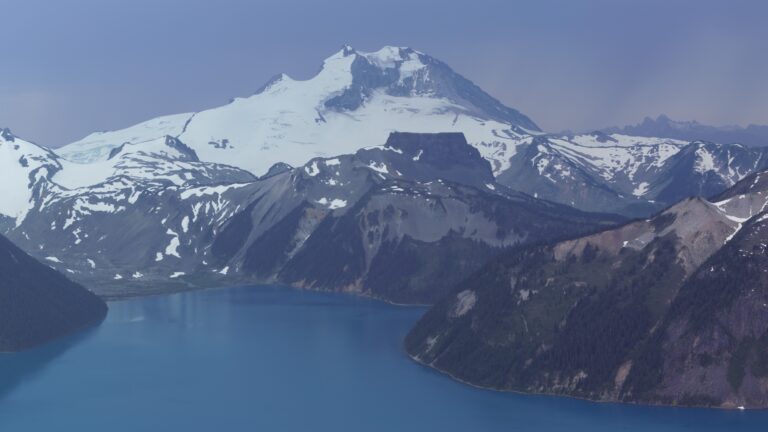
Abstract: The Cheakamus basalts are a set of Late Quaternary olivine basalts of the Garibaldi Volcanic Belt (GVB), the northern extent of the Cascades Volcanic Arc in British Columbia, Canada. They are known as a type locality of ‘basalt eskers’. The lavas, typically subaerial in nature along their ~27 km length, display unusual morphologies where they enter the Cheakamus valley from an adjacent drainage, forming narrow, elongate, steep-sided ridges of hackly columnar joints. In 1948, Bill Mathew posited these features formed via lava infiltration into subglacial drainage channels after an earlier, ice-free eruptive stage. New geochemical and paleomagnetic evidence indicates the lavas erupted over a short period of time (<200 years) from chemically indistinguishable magma batches, making a two-stage eruption over changing glacial conditions unlikely. New mapping identifies ubiquitous entablature jointing in lavas downstream of the ridges, suggesting wider-spread coolant infiltration. Erosional and depositional features indicate the Cheakamus valley was catastrophically reshaped after the Cheakamus basalts were emplaced. The size and nature of these features, which include extensive abandoned channel and cataract networks, 45 m-deep high-water marks incised in till, and expansion bars of boulders exceeding 15 m in diameter, require extreme discharges and volumes of water to form. The formation of the basalt ridges was thus likely a product of compounding volcanic and erosional processes, rather than solely glaciovolcanic in nature: the irregular jointing of the basalts resulted from paleofluvial system damming that overflowed and infiltrated the lava on the timescale of cooling. The basalts’ ‘esker-like’ morphologies are high-standing erosional remnants formed by the passage of a glacial lake outburst flood in the Cheakamus Valley ca. 10,500 years BP during deglaciation of the Cordilleran Ice Sheet. These results illustrate the complexity of assigning glaciovolcanic causes to valley-filling lava features in areas with a convoluted paleoenvironmental history.
Iestyn Barr, Linda Sobolewski and Tryggvi Unnsteinsson have just taken over as the new leaders to represent IAVCEI in the joint IAVCEI/IACS Volcano-Ice Interactions Commission. Our backgrounds cover a diverse range of topics related to volcano-ice interactions, including work on…
Abstract submission is now open for the 2025 IAVCEI Scientific Assembly. We would like to encourage everyone working on glaciovolcanism, in any shape or form, to consider joining and contributing to our Volcano-Ice session in Geneva next summer. We look…
The joint Volcano-Ice Interaction Commission (VIIC) of the International Associations of Cryospheric Sciences (IACS) and Volcanology and Chemistry of the Earth‘s Interior (IAVCEI) is inviting nominations for new IACS representatives to serve on the VIIC board. The VIIC is charged…

The VIIC is holding an online workshop from 13-15 January 2025. The workshop will be focusing on volcano-ice interactions but is suitable for both volcanologists and glaciologists in the same way. It is also open to everyone else interested in…
The Volcano-Ice Interactions Commission (VIIC), a joint commission of the International Association of Volcanology and Chemistry of the Earth’s Interior (IAVCEI) and the International Association of Cryospheric Sciences (IACS), is organizing an in-person workshop in Iceland in May 2025. Everyone…
Get in touch with us or tag us, @volc-ice.bsky.social, if you would like us to share anything related to #glaciovolcanism!
We would like to draw your attention to the EGU26 session GMPV10.8 “Volcano-glacier interactions on Earth and beyond”, taking place at the EGU General Assembly 2026 in Vienna from 3-8 May 2026. Abstract submission has now opened, and the submission…
When: Tuesday, 11th November 2025, 9 AM GMT Join us for our next seminar with our speaker Jodi Fox, Institute for Marine and Antarctic Studies, University of Tasmania, Australia. Jodi is presenting her work on marine sediment cores from Antarctica,…

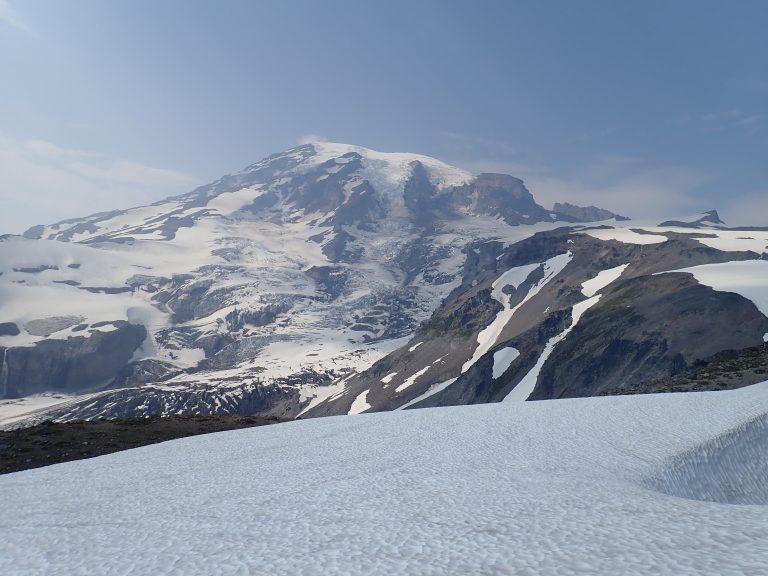
Northeastern flank of Mount Rainier from near Sunrise. Photograph by Jim Vallance.