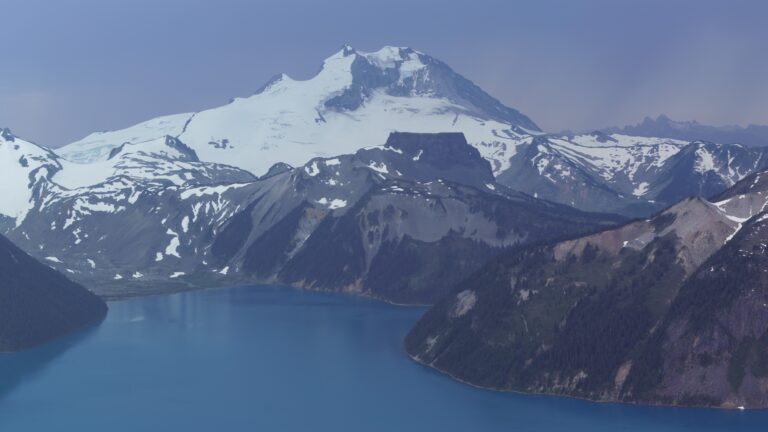
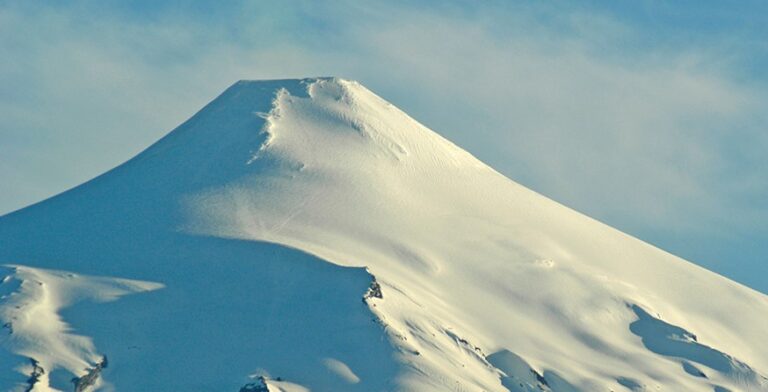
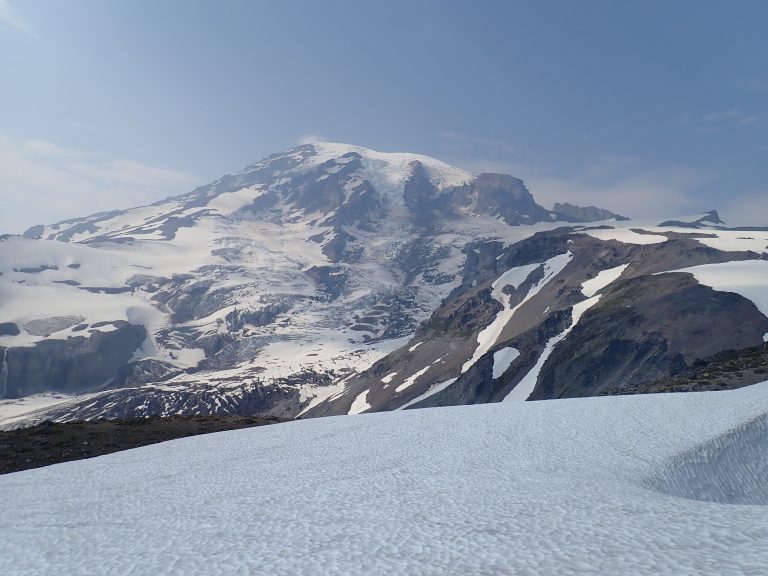
Northeastern flank of Mount Rainier from near Sunrise. Photograph from Jim Vallance.
VIIC field workshop in September 2026
Glaciovolcanism and hazards at Mount Rainier, Washington
13-18 September 2026
This field trip will examine volcanism, glaciation, and hazards at ice-clad Mount Rainier of the Cascades magmatic arc. The Pacific Northwest’s iconic volcano towers more than 4,000 m above surrounding lowlands and is the centerpiece of the spectacularly scenic Mount Rainier National Park. The volcano hosts the largest area of glacial ice and permanent snowfields of the conterminous U.S., and it fed much thicker and more extensive glacier systems through the Pleistocene. Evidence is ubiquitous for interactions between volcanism and glaciation, ranging from ice-impounded lava flows perched high above canyon floors to far-traveled voluminous lahars with only thin and inconspicuous coeval tephras. Collapse-prone areas of intensive hydrothermal alteration suggest an association with glacial ice as they required sources of abundant water to form. Because of its prominence and its threat to communities downstream, Mount Rainier has been a target for intensive scientific research and hazards assessment since the 1950s. The volcano has been mapped and its Holocene history delineated in great detail. Principal topics during the trip will include: (1) growth patterns of the volcano during its 500-ka lifespan; (2) regional and alpine glaciation; (3) lava-ice interaction; (4) hydrothermal alteration and its relationship to dikes and glacier ice; (5) Holocene volcanism; (6) lahar genesis and flow processes; and (7) volcano hazards. This trip will reprise the agenda of the IAVCEI 2017 Scientific Assembly field trip of August 2017 (see https://doi.org/10.3133/sir20175022A).
Northeastern flank of Mount Rainier from near Sunrise. Photograph from Jim Vallance.
This trip begins on Sunday September 13th mid-morning, assembling and loading vans at a location to be determined near the Seattle-Tacoma International Airport (SEA-TAC). Participants are responsible for their own travel to Seattle-Tacoma Airport. The trip will end Friday in late afternoon, returning participants to the pickup site. Fee includes three nights’ lodging at Crystal Mountain Ski Resort, two nights at Whittaker’s Bunkhouse (shared rooms), and transportation. Simple breakfasts and lunches will be provided but not dinners, which can be purchased from restaurants at/near the lodging locations.
The trip involves strenuous hiking three of the five days. Participants must be able to hike up to 15 kilometers (10 miles) (round trip) on steep trails with up to 700 m (2,200 feet) of relief. Cool to hot and fair weather is likely, but clouds and cold rain are always possible in the Pacific Northwest. Bring sunglasses, sunhat, warm clothes, raincoat, sturdy shoes or light boots, handlens, and small daypack. Swimwear is also recommended. Collecting of samples is not permitted within the National Park.
Cost
750 € (approximately $870 USD) includes park entry, printed field trip guide, five nights lodging, transportation, breakfast, lunch, and one dinner. Dinner and libations are available at or within easy walking distance of our lodging.
Registration
Registration for this field trip will be on a first come first serve basis. Please send an email to Linda Sobolewski (lindas@hi.is). Please indicate your full name, degree and current affiliation (if existing), and preferred email-address. We also ask you to provide a brief description about your scientific background and/or why you are interested in attending the workshop. A payment link to finalize the registration will be sent to participants after the registration deadline. The trip might be cancelled by the organizers if there are not enough registrations. Notifications will be sent a few days after the registration deadline. Trip limited to 20 participants.
Reimbursement rules for already paid registration fees: Cancelation until 31 July 2026 (11.59 pm CEST): 100% reimbursement; cancelation between 1 and 31 August 2026 (11.59 pm CEST): 50% reimbursement; cancelation after 31 August 2026: no reimbursement; in case of denied immigration: no reimbursement.
Registration deadline
15 May 2026
Payment deadline
31 May 2026
Financial support
This field trip is supported by the International Association of Volcanology and Chemistry of the Earth’s Interior (IAVCEI), the International Association of Cryospheric Sciences (IACS), and the International Union of Geodesy and Geophysics (IUGG). Membership is not required for participation and everyone interested in this topic is welcome to join. However, application for financial support requires an IAVCEI membership. Please contact Linda Sobolewski for more information.
Fieldtrip scientific leaders
Jim Vallance is a Research Geologist at the USGS Cascades Volcano Observatory. His research focuses on postglacial volcanism and hazards at volcanoes such as Mount Rainier and Mount St. Helens in Washington State, as well as volcanoes in Alaska and both Central and South America. He also studies the nature, behavior, and physical mechanics of lahars, floods, avalanches, pyroclastic flows, and dome growth. jvallance@usgs.gov
Tom Sisson is a Research Geologist at the USGS California Volcano Observatory. He has spent many years investigating the geologic history and volcano hazards of Mount Rainier, as well as studying volcanoes of the Middle East, the undersea geology of Kilauea, and the formation of the Sierra Nevada batholith. His research interests include experimental petrology and the volatile solubility of magmas. tsisson@usgs.gov
Logistics and Organization
Linda Sobolewski is a Post-Doc at the University of Iceland with specialization in glacier-volcano interactions. Linda co-leads the IAVCEI/IACS Volcano-Ice Interactions Commission. Among her research accomplishments is elucidating how the Crater Glacier at Mount St. Helens interacted with the emplacement of its lava dome. Her current research focuses on the decade-scale recovery of the Eyjafjallajökull ice cap, Iceland, after the 2010 summit eruption. lindas@hi.is
Carolyn Driedger is retired from the USGS Cascades Volcano Observatory. Study interests include glaciers, glacially derived debris flows, and volcano hazards. Carolyn aided development of inter-agency partnerships for volcano hazards reduction in the Pacific Northwest. Carolyn remains an active member of the IAVCEI/IACS Volcano-Ice Interactions Commission. Among other accomplishments, Carolyn and colleagues measured the thicknesses and calculated the volumes of glacial ice on Mounts Rainier, Hood, Shasta, and The Three Sisters. cmastin@usgs.gov
Scott Beason serves as Park Geologist at Mount Rainier National Park. His long-term study interests include landscape response to climate change, fluvial geomorphology, glaciology, and geologic hazards. Among his research accomplishments is reconstructing Mount Rainier’s glacial budget since the late 19th century, and developing forecasting and detection systems for localized debris flows. Scott_beason@nps.gov
Iestyn Barr, Linda Sobolewski and Tryggvi Unnsteinsson have just taken over as the new leaders to represent IAVCEI in the joint IAVCEI/IACS Volcano-Ice Interactions Commission. Our backgrounds cover a diverse range of topics related to volcano-ice interactions, including work on…
Abstract submission is now open for the 2025 IAVCEI Scientific Assembly. We would like to encourage everyone working on glaciovolcanism, in any shape or form, to consider joining and contributing to our Volcano-Ice session in Geneva next summer. We look…
The joint Volcano-Ice Interaction Commission (VIIC) of the International Associations of Cryospheric Sciences (IACS) and Volcanology and Chemistry of the Earth‘s Interior (IAVCEI) is inviting nominations for new IACS representatives to serve on the VIIC board. The VIIC is charged…
The VIIC is holding an online workshop from 13-15 January 2025. The workshop will be focusing on volcano-ice interactions but is suitable for both volcanologists and glaciologists in the same way. It is also open to everyone else interested in…
The Volcano-Ice Interactions Commission (VIIC), a joint commission of the International Association of Volcanology and Chemistry of the Earth’s Interior (IAVCEI) and the International Association of Cryospheric Sciences (IACS), is organizing an in-person workshop in Iceland in May 2025. Everyone…
We would like to draw your attention to the EGU26 session GMPV10.8 “Volcano-glacier interactions on Earth and beyond”, taking place at the EGU General Assembly 2026 in Vienna from 3-8 May 2026. Abstract submission has now opened, and the submission…
When: Tuesday, 11th November 2025, 9 AM GMT Join us for our next seminar with our speaker Jodi Fox, Institute for Marine and Antarctic Studies, University of Tasmania, Australia. Jodi is presenting her work on marine sediment cores from Antarctica,…