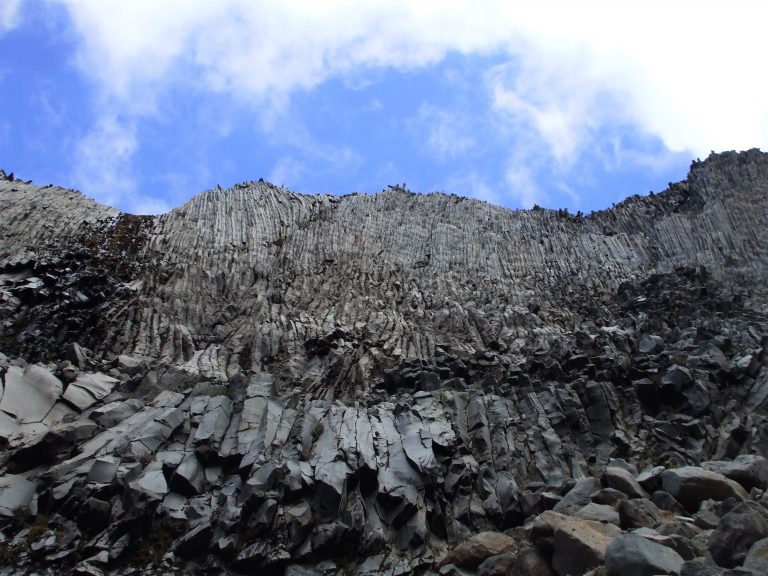
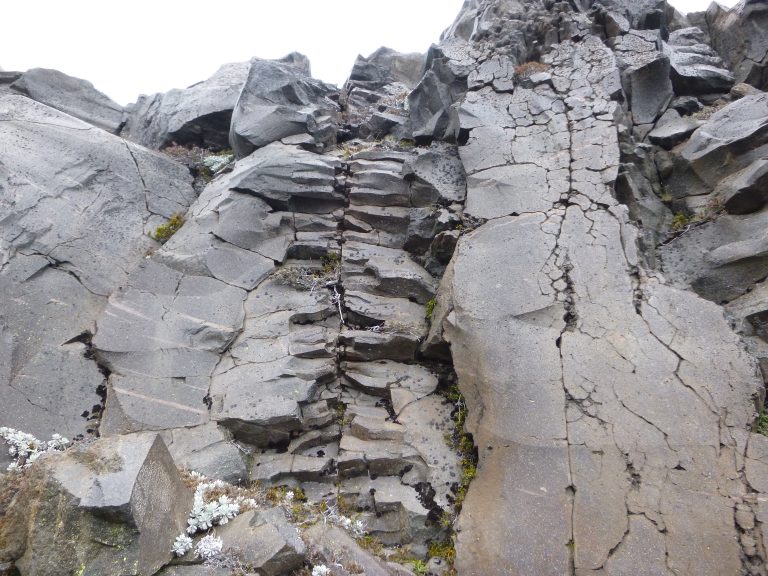
Fractures in a dacite lava flow at Ruapehu volcano, New Zealand (C. Conway)
EGU26 – Call for abstracts – Session GMPV10.8: Volcano-glacier interactions on Earth and beyond
We would like to draw your attention to the EGU26 session GMPV10.8 “Volcano-glacier interactions on Earth and beyond”, taking place at the EGU General Assembly 2026 in Vienna from 3-8 May 2026. Abstract submission has now opened, and the submission deadline is 15 January 2026, 13:00 CET.
We invite contributions from everyone working in the broad field of glaciovolcanism on Earth and beyond and hope for some interesting discussions and more interactions between people working on various aspects of this topic.
Glaciers and volcanoes interact in several ways, including instances where volcanic/geothermal activity alters glacier dynamics or mass balance, via subglacial eruptions or the deposition of supraglacial tephra. Glaciers can also impact volcanism, for example by directly influencing mechanisms of individual eruptions resulting in the construction of distinct edifices. Glaciers may also influence patterns of eruptive activity when mass balance changes adjust the load on volcanic systems, the water resources and hydrothermal systems. However, because of the remoteness of many glacio-volcanic environments, these interactions remain poorly understood.
In these complex settings, hazards associated with glacier-volcano interaction can vary from lava flows to volcanic ash, lahars, landslides, pyroclastic flows or glacial outburst floods. These can happen consecutively or simultaneously and affect not only the earth, but also glaciers, rivers and the atmosphere. As accumulating, melting, ripping or drifting glaciers generate signals as well as degassing, inflating/deflating or erupting volcanoes, the challenge is to study, understand and ultimately discriminate these potentially coexisting signals. We wish to fully include geophysical observations of current and recent events with geological observations and interpretations of deposits of past events. Glaciovolcanoes also often preserve a unique record of the glacial or non-glacial eruptive environment that is capable of significantly advancing our knowledge of how Earth’s climate system evolves.
We invite contributions that deal with the mitigation of the hazards associated with ice-covered volcanoes in the Arctic, Antarctic, globally and extraterrestrial, that improve the understanding of signals generated by ice-covered volcanoes, or studies focused on volcanic impacts on glaciers and vice versa. Research on recent activity is especially welcomed. This includes geological observations, e.g. of deposits in the field or remote-sensing data, together with experimental and modelling approaches. We also invite contributions from any part of the world and other planets on past activity, glaciovolcanic deposits and studies that address climate and environmental change through glaciovolcanic studies. We aim to bring together scientists from volcanology, glaciology, seismology, geodesy, hydrology, geomorphology and atmospheric science to enable a broad discussion and interaction.
More News
Column Forming Joints In An Andesite Lava Flow At Ruapehu Volcano, New Zealand (c Conway)
Welcome to the home page of the IAVCEI/IACS Joint Commission on Volcano–Ice Interactions. The Commission is charged with promoting research and interest in the complex interactions of magma and ice in all its forms (snow, firn, ice and meltwater), on…
Iestyn Barr, Linda Sobolewski and Tryggvi Unnsteinsson have just taken over as the new leaders to represent IAVCEI in the joint IAVCEI/IACS Volcano-Ice Interactions Commission. Our backgrounds cover a diverse range of topics related to volcano-ice interactions, including work on…
Abstract submission is now open for the 2025 IAVCEI Scientific Assembly. We would like to encourage everyone working on glaciovolcanism, in any shape or form, to consider joining and contributing to our Volcano-Ice session in Geneva next summer. We look…
The joint Volcano-Ice Interaction Commission (VIIC) of the International Associations of Cryospheric Sciences (IACS) and Volcanology and Chemistry of the Earth‘s Interior (IAVCEI) is inviting nominations for new IACS representatives to serve on the VIIC board. The VIIC is charged…
The VIIC is holding an online workshop from 13-15 January 2025. The workshop will be focusing on volcano-ice interactions but is suitable for both volcanologists and glaciologists in the same way. It is also open to everyone else interested in…
The Volcano-Ice Interactions Commission (VIIC), a joint commission of the International Association of Volcanology and Chemistry of the Earth’s Interior (IAVCEI) and the International Association of Cryospheric Sciences (IACS), is organizing an in-person workshop in Iceland in May 2025. Everyone…
When: Tuesday, 11th November 2025, 9 AM GMT Join us for our next seminar with our speaker Jodi Fox, Institute for Marine and Antarctic Studies, University of Tasmania, Australia. Jodi is presenting her work on marine sediment cores from Antarctica,…